jueves, 31 de julio de 2014

Pests and diseases


Control of pests and diseases is one of the most important –and controversial- aspects of viticulture. Some of them can seriously harm your vines, and thus yields, or even affect the quality of your grapes in a very direct way. Gray rot (botrytis) is one of the most feared, as it occurs shortly before harvest, normally after prolonged rain and periods of moisture. If not removed of eradicated, the rotten grapes give dirty flavors to the wine, and fermentation becomes much more difficult.


Keeping a vineyard in good shape is in some ways similar to keeping yourself healthy. First of all, a healthy soil and adequate nutrition are similar to eating healthy, nutritious food. Too much fertilizer, and the plant will grow in excess, much like your own stomach.
In general, plants with excess growth tend to create a lot of shade for themselves, where fungi and insects thrive. Very quick growth also gives thinner leaves and shoots that are less resistant to pests and diseases. Especially the incidence of grey rot is associated with an excess of nitrogen fertilizer.

But however healthy and robust your vines are, sooner or later they will be affected by some disease or other, that, if left untreated, will ruin your crop or even your vineyard. There are basically two ways of dealing with pests and diseases: using chemicals or not. The people not using chemicals are normally certified as practicing organic or biodynamic agriculture, and will never spray pesticides that were invented after the 1940s. I deliberately avoid the word “natural” pesticides in these cases, as they can still use (petroleum derived) mineral oils, sulfur, copper sulfates and other inorganic salts, some of which are not very good for the environment.
On the other hand, conventional agriculture has been relying probably too much on the use of pesticides, much in the way human medicine has been relying too much on antibiotics, leading to resistance of pathogens which makes their control increasingly difficult.

Personally, I think the practice of organic and biodynamic agriculture has shown us that that a lot can be done without the use of pesticides, however, practicing it dogmatically seems like missing the goal. Some of the sprays are not very effective, very expensive or even bad for the environment, like the copper salts used against downy mildew.
We're now boiling our own lime-sulfur as a general winter disinfectant. It is obtained by boiling lime and sulfur together for 50 minutes and then spraying it on the vineyard. It is caustic and smells bad, but otherwise pretty harmless, and avoids a lot of heavier sprays in spring. I found the recipe in a USDA manual printed in 1922!


Apart from trying to use as few pesticides as we can -saving a little money along the way!- here at Lagar de Bezana we try to increase natural health of our vines as much as we can. This year has seen the use of horses to eliminate winter weeds and add some natural fertiliser to the soil!


Otherwise, this winter has been cold and rainy, as it should be. While I write this, the Andes are giving me some beautiful sights in the afternoon.


viernes, 4 de octubre de 2013

Food and wine pairing

We're often asked what kind of dishes to served with the wines we produce. As we receive quite a few visitors for lunch during the year, it's a question we frequently ask ourselves as well.

To start with, the whole "science" behind food and wine pairing got a stir from research done in Japan, where it was found out that levels of iron in wine basically determine how well it pairs with fish. Wines with high levels of iron cause and unpleasant fishy taste in the mouth. Historically, red wine contained more iron than white wine, so that could be a valid reason for the recommendation of red wine with meat, white wine with fish. I get the same unpleasant sensation from eating apples after fish, and the browning of a cut apple apparently has something to do with high iron content as well.
This goes just to show how uncertain some of the established wisdom in food and wine pairing can be.
For those wanting to read the whole article:

http://news.sciencemag.org/asia/2009/10/why-fish-and-red-wine-dont-mix

At the winery we normally try to serve food that's in season, and if that happens to be asparagus, as is the case right now in spring, then so be it. Asparagus is difficult to pair with wine, but an absolute joy when fresh!
Otherwise, we favour lighter food, such as ravioli filled with corn (maize) with a tomato and basil sauce. Again, the tomato can clash with some of the wines, but normally they have enough acidity to cope well.
A wine with low acidity is the GSM (Grenache - Syrah - Mourvèdre), which is full bodied but not very tannic either. Lighter food but strongly flavoured, like mediterranean food such as fish or vegetables with garlic, anchovies, fresh herbs and so on, seem the best match.

During a recent trip to the United States, Ryan DiFranco of Difrancos.com in Denver, CO, paired our wines extremely well, the most surprising combination a lemon cheese cake with white chocolate with the Syrah Edición Limitada 2008. After Five years, the wine had become soft and rounded enough to pair well with the sweet flavours, and the lemon gave the whole experience a very fresh lift.

Another restaurant, near Grand Rapids, West Michigan, (unfortunately I forgot the name) prepared the best surf-and-turf I have ever eaten to pair with the Aluvión 2008 and 2002. In this case, the dish suddenly made sense, the earthiness of the shrimp complementing the meat and wine in the best way you can possibly imagine!


viernes, 27 de septiembre de 2013

Tilling, fertilization and cover crops


Now that winter is over, I’d like to share a few thoughts on soil maintenance. It is difficult to understate the importance of the soil, as it sustains everything we grow. 
Since last year we’ve been ploughing the soil between the vines more and more as a means to aerate the soil and control weeds. Aeration is normally taken care of by worms and insects living in the soils and digging their way through them, but compactation by tractor wheels and a lack of plants to sustain soil life have made it necessary to plough. In order not to overdo it, we started by ploughing alternate rows.


The lack of plants to sustain soil life basically means the lack of weeds: their roots can help to break up the soil and feed insects and worms living in the soil. We’ve started to experiment with cover crops to observe their effect. The goal is to accumulate biomass in the soil, while at the same time trying not to have these crops compete to hard with the vines for water and nutrients. This means we favor plants that grow in winter, seed and then dry up starting in spring. Mustard is one such crop and has bright yellow flowers before the vines start budding.


To avoid competition for nutrients it's best to fertilize cover crops while you sow them. For ease of application and their low cost we use chemical fertilizers. There’s nothing wrong with them, as long as you don’t abuse. In the end, the cover crops, as the decay, will return these and other nutrients to the soil, which will favor the vines in the long run.
Otherwise, we use stable manure (from cows and horses) as fertilizer, which has the added benefits of adding organic matter as well as micronutrients to the soil, but is harder to obtain and handle, as quantities are big.
The only other (micro) nutrient we’ll be using this year is zinc, as the level in both soil and plants last year proved to be low. The plants only use minute quantities of this mineral, but the lack of it causes stunted growth and shatter of berries.

Alternatively, after ploughing, native vegetation starts to grow, and seems almost as beneficial for the soil as cover crops. Grasses and wild flowers seem to be the mainstay.


We’d like to see some clover or leguminous plants as well, so next year we’ll be sowing some of those, apart from the mustard seed. Other cover crops we tried were less of a success. Oats and vetch were mostly eaten by birds early in winter. Growing a mixture of grasses gave almost the same result as the grasses that grow here naturally, so that was a bit of a waste of money!

All in all, weed control is getting easier, as the hardest ones to control are being outgrown by these smaller ones in winter, and we’ve been controlling the former as early as we can, to avoid propagation.

Pruning has finished by now, and we’re busy tying down the last canes before budburst occurs. We just had some heavy frost that badly affected fruit growers all over the central part of Chile. Fortunately our vines bud a little later than most as this area is fairly cool, so we were not affected at all. Maybe an indication we’re growing the right crop in the right place?

And for those of you trying to find the winery, the gate is not green any more but now painted in “Lagar Red,” a color taken from the wall painting in our tasting room and now very distinctively ours!
The Chilean flag in the background is mandatory, to celebrate Chilean independence (18 September).


viernes, 28 de junio de 2013

Pruning and beginning of winter


Winter pruning has started and the weather has been cold! Almost every morning the vineyard is covered with frost.


Meanwhile, in the cellar, we’re pressing off the last tanks and putting the wine in barrels. We bought new Radoux and Saury barrels, and 4 “demi-muids” or large 600 liter barrels for the Syrah Edición Limitada. Now is the time to decide which wine merits more new oak, and which doesn’t.


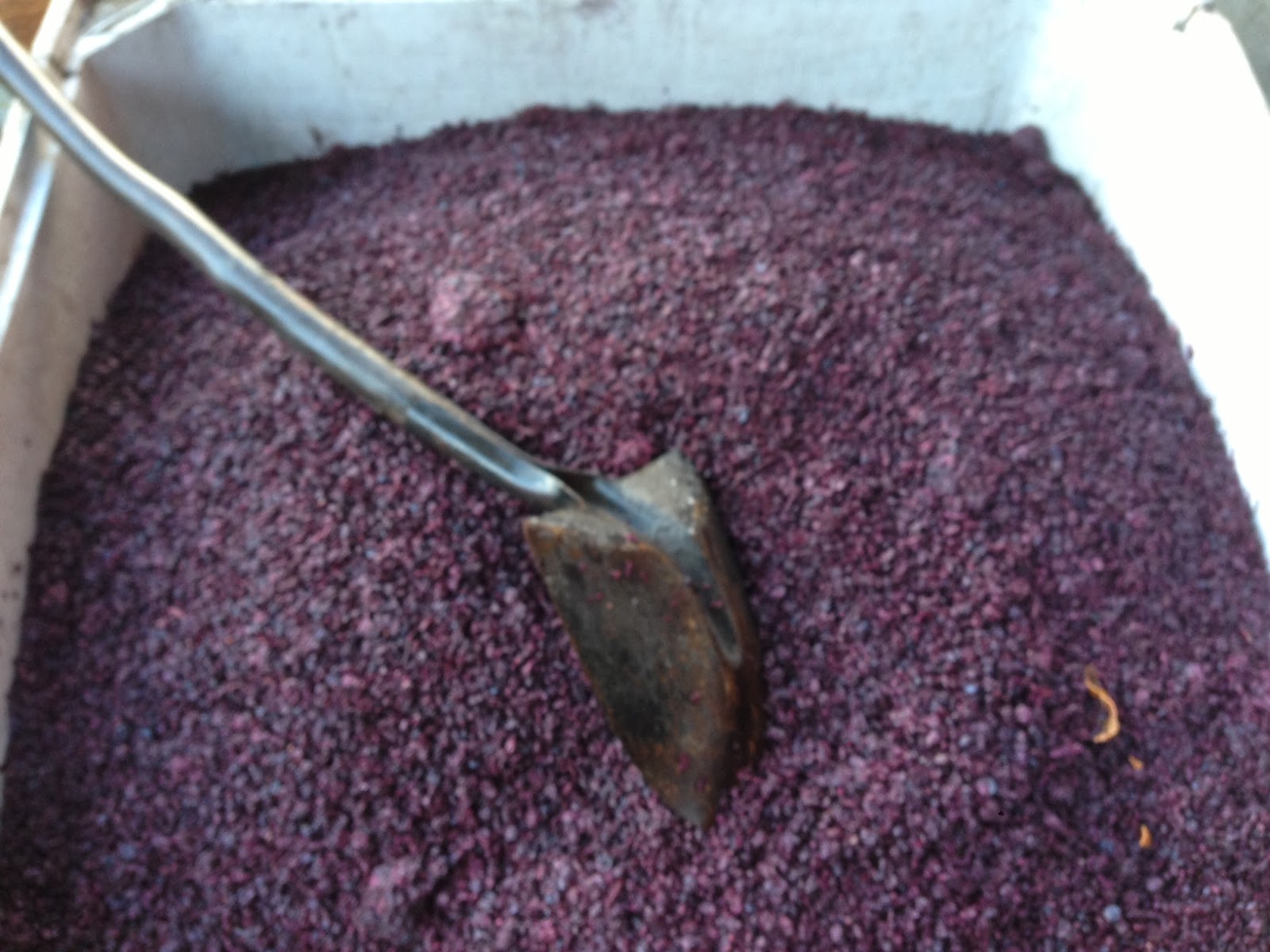
The pomace, left after pressing, in composted before it goes back to the vineyard, to enrich the soil.


This year we decided to plough the whole vineyard, to get some air into the soil, improve infiltration of rainwater and stimulate growth. We’re also doing experiments with cover crops. Last year that wasn’t such a success, as we were a little late with sowing and the soil wasn’t prepared well enough. Hopefully this year will give more results. The mustard is growing very fast, the oats have shown less signs of life. Apart from the utility, I like the way a ploughed soil looks in winter.


We’ve also been buying stable manure again this winter, as manure and compost bring not only nutrients, but also new life to the soil. There’s a nice pile waiting to be spread out in the vineyard.

Orders have been coming in from different parts of the world. At the moment we’re about to ship to Holland, Canada and the US. This is the first time we’re exporting to Holland, and our hopes are high! While we were preparing an order, it was raining cats and dogs. To make matters worse, the tractor wasn't able to handle the weight of the pallets. But with a little human weight added, that was fixed. Man and machine, what a combination!


The results from the photo session with Matt Wilson also came in. There have been all kinds of comments and discussions. This is one of the more controversial ones. Flanked by two beautiful girls from Santiago (our manager and her assistant), I was the dirty one who had to do all the hard work!


Apart from that, everything has been fairly quiet, which is just as well, as it’s been so cold and rainy. Today I sent the workers home earlier, as more rain threatened, and there wasn’t much left to do. Personally, I took shelter at home, intending to make good use of all this firewood!


miércoles, 29 de mayo de 2013

Harvest 2013 and visitors


This week, the 2013 harvest has finally finished. This year took a little longer as there were a lot of grapes and we decided to make more wine than last year. More than double the amount of last year, as a matter of fact.
After a fairly cool summer, I expected rain to fall early in autumn, but so far we’ve only had rain twice, and it didn’t do much damage. Even Syrah, with its tight bunches, didn’t have any rot to speak of.
We only had some frost a week ago, which caused all the leaves to drop and made us speed up the end of harvest. Fortunately, frost doesn’t affect the quality of the grapes once they’re ripe (it does damage unripe grapes), but having them hanging in bare sun during the day can’t be too good either!

Meanwhile, in the cellar, the last tanks are slowly fermenting and the first wines are finished, have been pressed and put in barrels. Fermentations are quite slow, as the weather is very cold at the moment, which slows down the activity of the yeasts. This is not a problem, as it gives more time to extract color and tannins and evaluate the fermenting must. So far, colors are very intense and aromas are fruity and already quite expressive. Now we have to wait for malolactic fermentation to complete over the course of winter and spring to be able to evaluate, select and blend the final wines.

During harvest we had a few visitors, unlike last year, and they were a very welcome distraction during what was one of the longest harvests at Lagar!
Some of the most memorable were Janesse and Ben and their little son from “The Bottle Shop” in Colorado. During our visit to the vineyard, the dogs managed to catch a rabbit and tore it to pieces in front of our eyes! Animal planet live!!! I have to confess I felt quite embarrassed, especially for the boy, but that’s nature. We’re at the feet of the Andes, not in the middle of a big city. Apart from that it was a great visit, and I was sorry they couldn’t stay for lunch. Maybe next year?

Henry Hudson and Joaquin Perez from South American Boutique Imports arrived in the dark, and the electricity had fallen out. This happens a few times a year since the area is quite remote, but this was extremely bad timing. The staff had left already, since there was little to do in the dark. We had to receive them in a candlelit tasting room, which looked very romantic! Anyway, they didn’t mind too much and we had a great tasting. This is how the tasting room looks like when lit:


Another visit was from our importer in Corea, In-Suk Chung and his deputy manager Young-jin Choi. I had never had visitors from Asia, so we were a bit nervous at first, but what great people they were. Very knowledgeable and very sure of their tastes, more so than most Europeans who are supposed to come from the cradle of viticulture. Apart from sharing a very pleasant lunch including a bottle of the 2004 Aluvión, they handed us lovely gifts, which we didn’t expect at all! We’ll have to start working on our “Lagar” t-shirts to be able to retribute our visitors.


Our trainee, Isaac, and his wife and children left last Sunday for Peru and then back to Holland. They were great to have as company and a fantastic help in the cellar as well. We already miss them, but that’s the way harvests go. At the end of each one you have to say goodbye to all the people that helped so much and were an integral part of the process, but the rest of the year we have to make do by ourselves. After a last dinner (the picture shows what was left over, note the bottle of Inca Cola, Isaac has Dutch-Peruvian origins) they left for a last day in Santiago.


Just after the last grapes came in, the rain really started. We’ve only been doing some cleaning and labeling, as it’s raining cat’s and dogs. Speaking of dogs: they were all lying in their houses looking quite depressed, as they weren’t able to run and play outside. To add insult to injury, the vet came for their yearly vaccinations. The look on their faces said it all!


martes, 16 de abril de 2013

Bottling and beginning of harvest


Harvest has finally begun. This summer was a bit cooler than usual, and much cooler than 2012, so we started about two weeks later than last year. Although the shy has been grey a few days, and it has been menacing with rain, so far, only a few drops have fallen, so no risk of rot at all. The Syrah is looking even healthier than last year, which has us very happy. Temperatures can still get over 30ºC (86ºF) during the day, but at night we've registered temperatures as low as 1.5ºC (35ºF)!

Taking advantage of the last quiet moments before the harvest, I walked up to the hill of La Compañía last Sunday, to have a different perspective of the valley. Lagar’s vineyards are in the middle, at the foot of the first hill in the background.


Seen from the vineyard the hill looks like this, but I can assure it’s taller than it looks once you’ve tried to climb it! In the foreground the Malbec we planted last year. We can't wait to see the first grapes!


The first barrels for this year’s harvest have arrived, this time customized with the logo of Lagar! These are the 600 liter barrels for the Syrah.


The last two weeks we’ve been bottling about everything there was left in the cellar. Demand for our Cabernet Sauvignon Reserva has been very high, so we had to bottle a bit earlier than planned. This was a good thing, as this year we’ll be making a lot of wine, so we can use the extra space! Only the Syrah Edición Limitada and the base wines for Aluvión 2012 are left.
Despite me having a cold, bottling went very quickly and without problems. This is fairly unusual, as normally something fails, such as corks, capsules, cases or space to store all the bottles.

The neighbors have been a great help too: since one of our tractors broke down, they borrowed theirs, so Fernando, the vineyard manager, is proudly driving a brand new Massey-Ferguson this month. Unfortunately only for this month…


Our trainee for this year, Isaac, has arrived from Holland and is now fully integrated into the team and has proven to be a great help.
Apart from that, we had a bit of a rough start, this year. First, I suffered a motorcycle accident the weekend before we started (at last the limp has gone, only some bruises are left on the soul!), then, on Monday the must pump failed, putting our skills as electricians to the test, and on Tuesday the destemmer-crusher. This last machine, after more than three hours testing voltages, currents and circuits, was the easiest to fix, when the cellar master decided to simply change the plug! Meanwhile, the harvesters were almost screaming for more cases (they are paid per kilo), so even our team’s social skills were necessary to keep things quiet!

We started harvesting Syrah, and perfectly healthy, ripe fruit arrived at the cellar.


Here’s Isaac and Jorge emptying a case into the destemmer.


Most of the vines are still healthy and green, but the Teinturier plants are a deep purple red. They were the first to be harvested, and the accumulation of color in both grapes and even leaves is quite spectacular. Even Romeo, the dog in the foreground, was impressed!


Fermentations have started, so there’s a lot to do at the moment. Hopefully by next month I can give more details about this year’s harvest. Meanwhile, enjoy our Syrah 2010 that earned much praise in this Months Wine Spectator!


lunes, 11 de febrero de 2013

Beginning of ripening


It has been a while since my last post and there is a lot to be told.
There has been a lot of work in the vineyards, as this growing season has not been very easy. There has been rain in december and temperatures have been lower than average, and pressure of powdery mildew (the “good weather fungus”) has been high. We’ve been able to eradicate the few outbreaks we had, and the grapes have started to ripen, which means the end of the risk of new infections. Now we have to be alert for grey rot, or botrytis bunch rot, which can be a serious threat to the Syrah especially. Due to the cooler weather, we're about two weeks behind schedule compared to a normal year. maybe this means a more relaxed harvest, as not everything will ripen at once, like last year.

Last year’s experiments are showing good results:
One of the things we tried to do was to get a more even budburst and growth of the shoots of Cabernet Sauvignon. When pruned early, normally the last two buds left on a cane grow much more than the other ones (a cane having 6 – 8 buds). When the whole cane is left intact at pruning, and is shortened while budburst is about to occur, the shoots grow much more evenly.
The effect of a late re-pruning is slightly devigorating, not in the least because it promotes fruitfulness, and the fruit takes away energy from the plant. We therefore only tried it in the more vigorous parts of the vineyard, and we’re very happy with the results.
The first picture shows a typical Cabernet cane, with weak and absent shoots in the middle. Note the poor bunches in the middle as well, compared to the ones on the last two shoots (to the left).
The second one shows the result of the experiment: smallish, but good and evenly colored bunches along the entire cane!


Applying stable manure has also worked well for those plants which were not growing much. As a result, I observed earthworms last year, a sign of healthy, living soil. Only Carmenère is still a bit reluctant to grow, but there are signs it is improving. We need the roots to go deeper in search for water and nutrients. Last year we saw a shallow root system, and it will take a few growing seasons to promote new and deeper root growth.

Liming the soils has given good results too. Even though the soil is not poor in calcium, lime (calcium carbonate) can help to free nutrients and change the pH of the soil, which has a profound effect on the roots.

The last experiments have to do with a fungal disease which attacks the wood of the vine. The symptoms are stunted growth, with yellowing margins on the leaves, as can be seen on this picture. Note the healthy leaves and bunches on the right.

The fungus penetrates the wood through large pruning wounds, such as this one:


Unfortunately, the symptoms are only clearly visible in summer, but not when pruning in winter. To overcome this, we’re busy marking with a plastic ribbon each plant showing singns of the disease. When pruning, these plants can be treated differently. Basically, they’ll be cut or sawn off, until clean and healthy wood appears. The resulting wound will be dressed with fungicide paste, and hopefully the disease can be kept at bay.

Labor has been scarce, although so far we've had little problems. Only after bud burst did we have a little delay on the de-suckering. But the other day, driving through the village of Graneros, I saw these signs, virtually crying out for people to harvest fruit, like peaches and nectarines, that's ripening at the moment, promising generous weekly pays and so on. Clearly the gentleman sitting at the bottom didn't think this was worth the effort. Hopefully, by the time we harvest our grapes, he'll feel more enthusiastic!


miércoles, 19 de diciembre de 2012

Summer rain in the Alto Cachapoal


Something unusual is happening at the moment: it’s raining in the Alto Cachapoal! And not just a drizzle but real rain, and lots of it, starting last night and continuing until tomorrow. Our growing season is mostly dry, from October until March, so we depend on irrigation water from the Andes to get our grapes ripe, unless something like this happens.
Fortunately, the rain caught us by surprise but we were prepared: we’d just sprayed against fungal diseases, and although we were about to stop irrigating for a while, to start preparing the vines for summer, this rain will probably not penetrate to the depths of the soil where most roots are. Our soils are gravelly and deep and drain very well, so there is less to worry about. There are just some drops falling in my office, due to an obstructed draining pipe...
This season has been cool almost since the start. Only a few weeks before flowering and the occasional day in between was there any real heat, which at least is good for the workers. The cool weather has caused some uneven fruit set, so we won’t be looking at a huge harvest. Qualitatively this is interesting though, as long as we get to adequate ripeness.
Our vineyard management last year has yielded its fruits as well: the 2012 wines have more freshness and color than ever, and tannins are integrating well. This means less need for fining and the result is better and more natural wines. Malolactic fermentations were slow, but almost all batches are finished by now. We hope to do a first complete assessment of what we have in barrels soon.
Christmas is next week, so these last weeks have been busier than usual. We got quite a few orders during November and December to keep us busy. Some lunches and dinners this week, and this Friday we’ll have a barbecue (if the weather allows!) with our staff before the holidays.
The team at Lagar de Bezana wishes all our readers -and drinkers- the best for the
Holidays and a good start in 2013!!!

martes, 30 de octubre de 2012

Carmenère

Recently, this winemaker was asked by editor Silvia Mascella Rosa to write an article on Carmenère in Chile for the Brazilian magazine DiVino-Sabores.
Lagar de Bezana grows a little Carmenère, which is showing better results year after year. The 2010 Aluvión inludes 15% Carmenère and we hope to be able to continue this in the future.
For those interested, I include tha erticle here. The wines recommended in the article were not chosen by me, as some people were quick to observe!


Lagar in Brazil !!!

Last week I was in Brazil to present the wines of Lagar de Bezana, together with Rafael Tirado, owner and winemaker of Laberinto.
Thanks to all the people that received us so well! It was truly a pleasure to meet people so enthusiastic about food and wine.
On 28 October, the newspaper Agazeta published the following article on our wines. Many thanks to Boris of Ville du Vin to send it to us.


martes, 2 de octubre de 2012

A week in the life of a winemaker


I was recently asked what a typical day for me looks like at the vineyard. There are days that I hardly get out of the office, or when I have to go to Santiago or somewhere else. So this post is about a week in the life of the winemaker of Lagar de Bezana.

Monday
After a week off, to celebrate Chile’s independence, personnel returned on Monday. In the morning, I walked through the vineyard with Miguel, the vineyard manager, to see what had been happening in our absence. Of all the varieties, only Petit Verdot was actively budding. Especially Cabernet was giving few signs of activity yet. The weeds have been growing a little, and some are difficult to control, so this week we’ll control them by hand or with herbicides, depending on which part of the vineyard they’re in.
I then went quickly to Santiago, as I had a borrowed filter that had to be returned to it’s rightful owner. Taking advantage of the trip, I took 30 cases of wine and several documents to our head office in Santiago, where I also met Felipe Kaufmann, an extremely friendly Wine Advisor from Brazil who loved our wines. He promised to come and visit the cellar during summer.
On my way back from Santiago I bought a few rose bushes for the vineyard at Ludwig Sehrt, a german-chilean nursery. People always ask why we have roses growing in the vineyard. They’re only there because they look beautiful, but some people think they can alert early for an attack of powdery mildew. The variety I bought, Puzsta, is extremely susceptible to mildew, so I had them planted near the office, to see if they really get powdery mildew earlier than the vines and how much time we have between an attack in the roses and in the vineyard.
I was back at the office only at 4:30h. Santiago is extremely full of traffic and it takes ages to get from one part of the city to the other. I first went to see how the labeling of was going, as tomorrow we have to export a few pallets of wine to Korea. I then had a look at the lab results from the week before, to see if  malolactic fermentations of the 2012 vintage are finishing and answered a few more mails.
After work I drove to Rancagua to an appointment with a physiotherapist (my shoulder has been hurting a lot) and then a while to the gym, before returning home at 11:00 h for a quick meal and then to bed.

Tuesday
We were busy all morning with the export to Korea. The forklift was still out of order, so I had to ask a neighbor to borrow his for a while. We assembled the cases of wine on the pallets and put them on the truck, which took almost all morning! The documents take a while too, as these have to be done very precisely.
Meanwhile, the girls that were busy tying down the shoots advised me that they had finished, which officially ended this year’s pruning. I had expected them to be busy all week, but the little machines we bought last year have made the job a lot easier and quicker.
After a lot of administrative work after lunch, my brain felt a little burned, so before the day was over I went to see the results of the cover crops we’ve sown between the rows in a corner of the vineyard. The goal of a cover crop is to add or recycle nutrients and organic material to the soil, avoid erosion (not our case) or decrease vigor of the vineyards. That is why we did the experiment in a vigorous part of the vineyard, in case the vines would be really affected. Anyhow, they haven’t come up very well, probably because we were a little late with sowing and the seed bed wasn’t well prepared. Next year we’ll definitely continue the experiment.
After work I went to the physiotherapist again and then to the swimming pool for an hour. Today has been the first really warm day of the year, so the swimming pool was a welcome refreshment. I was a little tired after that so I got some Chinese food for dinner on my way back from Rancagua, before going to bed.

Wednesday
Since the forklift was still not working and a tractor had broken down on Monday, I went with Miguel to Rancagua, to see if we could find the spare parts we needed. I also went to the bank, to get a new checkbook and to the supermarket, to buy silk paper to wrap a few bottles that had their back labels damaged while being transported in their cases. This took all morning, as the spare parts were impossible to find.
On the way back we stopped in the village to order sand and gravel, to repair the decanter pools. Before the water is used for irrigation, it has to pass through two pools, to let the sand and other particles drop to the bottom. This is to avoid the drippers getting obstructed. In the past, people had destroyed this system, as they didn’t probably understand it. Since a lot of drippers get obstructed every year, we had decided to restore this system, which is more work than we expected!
After a late lunch, I answered my e-mails and went to the vineyard to try the new hoes I brought with me from Holland. One of our workers had been working all day to put stems back on these tools, as I was able to bring only the metal parts with me on the airplane one month ago. You must be asking yourself: why does this guys bring hoes with him from Holland? The reason is simple: there are no decent hoes to be found in Chile, especially no hoes that don’t break your back! Anyway, they seem to be working fine, so tomorrow we’ll put the to good use.
After work, to the physiotherapist again, and on my way back I bought some artichokes for dinner. They’re in full season now, and sold along the motorway between Codegua and Rancagua. Delicious!

Thursday
The grafter called early this morning to say he wasn’t coming until Saturday, as it was raining. It wasn’t raining here, just a little foggy, but he still wasn’t coming… I was busy with mails and other office work when Claudio Cereghino dropped by. Claudio is a good frend who works for Nadalié, a cooperage I have bought my 600 litre barrels at. We tasted through several tanks and barrels, and the wines are looking a bit disjointed at the moment. Air temperatures are rising and malolactic fermentations are resuming after a cold winter. This makes the wines become cloudier again and taste a little strange. Nothing to be worried about, but the wines that are finished have to be analysed and racked clean from barrel to barrel. Sulfites are added to protect against oxidations during summer.
With Miguel, we then went to Rancagua again, for the now famous but inexistent spare parts and to rent a machine to break the cement on the decanter pools.
On our way back, we had lunch at the famous “Mini” restaurant, formerly “Mini Sheraton”! Excellent food, and not expensive at all. No wonder why I see so many cars parked there every day.
In the afternoon we worked on the salaries that will be paid next week. Many people get paid additionally for what they produce every month, which is a lot of work to calculate.
After work I went to the gym and after dinner had a long read before going to bed.

Friday
The girl that works at the lab called early to be picked up from the bus station. Since the dogs seemed very hungry, I fed them, although the guard normally does this. I then heard that the guard had given them food already, so they got fed twice. Lucky them! They layed basking in the sun for the rest of the morning, digesting all this food.
After discussing todays lab work, people from the office in Santiago showed up early, to install a new water pump. Since we’re part of a radio station that has a very capable electrician, I asked him to install a new pump, as the old one is showing signs of wanting to give up the gost. I knew the installation was not very good, but apparently it was so bad we ran the risk of getting electrocuted any moment! They ended up being busy all day.
Having a look at the pools, I found the guy breaking the cement working without ear plugs. It is difficult to make people understand it’s in their own best interest to protect themselves, and can be very tiresome.
We then discussed with Miguel the possibility of releasing chicken in the vineyard to control weeds. The warm weather has really favored their growth, but we’re trying to use as little herbicide as possible. One of our workers has recently acquired 100 chicken, and chicken love anything green. This would mean having to close off part of the vineyard with nets and building a mobile hen house, to house them at night. I inquired after the price of nets, and Miguel will work on project Mobile Hen House!
I also coordinated with the grafter to come during the weekend. The vineyard where our Grenache and Mouvèdre is planted still has a few rows of petit Verdot. We want these plants grafted with Grenache, as the Petit Verdot wasn’t doing to well here. It also eases work in the vineyard, as Petit Verdot has very different needs compared to Grenache, when it comes to pruning, spraying, irrigation etc.
The people have been lowering the foliage wires in the vineyard. As the shoots grow, we keep them upright with these wires, but before they have grown enough, we don’t want them to get tangled up in the wires. That is why they are moved close to the ground after pruning.
After lunch, at around 3:00 h I went to Santiago, to take samples of wine to the lab, to confirm that malolactic fermentation is really finished on some wines. I took some cases of wine to the office and picked up my mail, before going to a wine fair at the Plaza San Francisco Hotel, where I was pouring wine all afternoon and night together with other members of MOVI, the “Movimiento de Viñateros Independientes,” an organization of small wineries we belong to. Since I hadn’t had dinner, the people of the hotel were kind enough to serve some snacks and sandwiches. There were lots of people, and apart from the customers, I had a few chats with other members and exchanged some bottles of wine with Mauro von Siebenthal, of the Von Siebenthal winery in Aconcagua. His wines are excellent, so make sure to look out for them, as well as Lagar’s when shopping.
That night I stayed at a hotel in Santiago, as the fair was only over by 11:30 h and after working fifteen and a half hours, I didn’t feel like driving back to Codegua.

I’ll leave out the details of the weekend, as I gathered with a few friends, and probably had a bit too much to eat and drink! Sunday evening I drove back to Codegua, for another week of work.

martes, 14 de agosto de 2012

Pruning and replanting


After the rains at the beginning of June, weather improved so pruning got well under way under sunny and cool conditions. Our vines were formerly cordon-trained and spur pruned, but changed to cane pruning a few years ago. This makes pruning slower, as there are often large chunks of old wood that have to be sawn off. As the wood of Cabernet Sauvignon is very sensitive to fungal diseases, especially when large cuts are made, I tried to find ways to avoid the use of a saw.
At pruning you leave enough buds of last year’s wood that you consider adequate. More buds means more fruit and less vigorous shoots, which prematurely ages the vine. Too few buds yield less fruit and more leaves. The leaves will shade the fruit, so the taste will be greener. At the same time, you have to think in advance, about where you want next year’s fruitful canes. If you leave only canes, you’ll need a bit of luck to find a cane in the right position the following year. A spur will yield one or two canes, so this is a practical way to ensure good canes for next year’s pruning.
I decided to leave a few spurs per plant (again) that should yield next year’s canes. This avoids much sawing, as you use up the whole extent of the plant: canes wherever you seem fit, and spurs wherever you want next year’s canes, instead of selecting the two or three best canes and sawing the rest off. Hopefully this will work out, as future harvests depend on this.
The question of spurs over canes can become an almost doctrinal one, with firm defenders of either system. In my view, some varieties, like Grenache or Syrah, need only short spurs, as longer canes will bear more fruit than the plant can handle. Others, like Carmenère or table grapes like Thompson Seedless, need long canes to bear any fruit at all. Cabernet is somewhere in between. Especially in our case, with older plants derived from cuttings from other, old, vineyards, canes are the only way to obtain a decent crop. The plants have not been selected for fruitfulness, so yields tend to be lower and less predictable than on plants derived from clonal stock.
That question over, we turned our attention to the soil. We started by spreading manure in the vineyard, especially in those parts that seem to be more in need of it. We bought the manure earlier this year from farms around us, and it had composted really well. We’ll also be trying several cover crops this year. Since we have no experience with them, we’ll start out with a few trials. Cover crops are low growing plants that cover the soil between the vines during the year or only during a part of it. They are considered beneficial for the soil, avoiding erosion, adding organic matter and increasing soil life. On the other hand, they can compete with the vines for water and nutrients, which is potentially harmful. The issue is to find a balance between the two: enough vigor on the vines and as much cover of the soil as possible.
To grow our cover crops we’ve selected three types of seeds. The first one is a mixture of native grasses that grow in winter and dry up in summer, for which I have high hopes. The second mixture is a classic: oats and vetch. The oats add much organic matter when ploughed into the soil in spring and vetch fixes nitrogen, the most important nutrient for grapevines and almost any other plant. The third is mustard, which grows vigorously, so it increases organic matter in the soil when ploughed in, but also antagonizes nematodes that live in the soil and feed on vine roots. The effect is not studied enough, but certainly worth a try. We’ll also be adding some wild flowers, for diversity and beauty. Of course these will be sown close to the entrance, where everyone can see them!
The manure and cover cops lead me to the third issue that has been busying my mind during the last few weeks: the one of organic, biodynamic and sustainable agriculture.
Often people ask us if we haven’t considered switching to organic or biodynamic agriculture. Our consultant, Cristóbal Undurraga, manages his own vineyards biodynamically, so he would certainly look favorably upon such a change in our vineyards. On the other hand, I feel that at least a limited use of pesticides is justified when trying to obtain better grapes. I’ve known a few producers that work their vineyards according to organic or biodynamic principles, but will use occasionally some pesticide when strictly needed. Even if the would not use pestcides, they don’t feel the need to certify organic or biodynamic practices, as their customers know and trust the quality of their wines. A producer I much admire for this, and the quality of his wines, is Pierre Gassmann of Rolly-Gassmann in Alsace.
Another eye opener was the book “The omnivore’s dilemma” by …. . In it, the author describes different food production systems. It appears that many organic systems have become so large in scale, and the rules imposed can be so non-sensical, that the whole spirit behind organics (locally produced, seasonal, healthy food that doesn’t rely on inputs from outside the farm such as pesticides or fertilizers) has gone lost. The same goes for biodynamics: the founder, Rudolph Steiner, was against the drinking of alcohol and wanted his followers to live in small, self-sustainable farming communities. Now try explaining that to somebody who wants a glass of Lagar de Bezana’s Aluvión after a hard day’s work at the office in Manhattan!
I think the processes we use are becoming more and more environmentally friendly and sustainable, and it would be interesting to find a certification for that. For the time being, you’ll have to take my word that we’re trying our utmost to keep our workers, wines, vines and soil healthy. Otherwise, come and find it out for yourself!

lunes, 25 de junio de 2012

Beginning of winter at Lagar


This post is written in Santa Fe, New Mexico, where I am to present our wines to our importer in the USA. They have been very well received in San Diego, despite a huge offer of wines from all over the world in the market here. The people are really friendly and the weather has been great, which is a welcome change from the chilean winter!
It has been raining quite a lot in Chile this year, which is always a good thing, except if you have to work under it. We have had some night frosts and the vines have lost all their leaves now, so we’re preparing winter pruning. Since we like doing experiments very much, this year will see some new things in the vineyard. First of all, we’ll be making are own dressing for pruning wounds. The University of California –Chilean universities are very silent on the subject- recommends other ingredients than are available in ready-made dressings, which made us decide to make our own. This also allows us to control the stickiness and adhesion of the dressing, so we can obtain just the kind of product we like to work with. We could even change the color if we’d like to!
Since most of our vines stem from a selection of cuttings from old vineyards rather than certified, clonal plant material, some of the plants have diseases, and it is important to avoid them spreading, hence the importance of pruning wound dressings. To try to rescue the diseased plants we’ll cut the bad parts off (normally almost the entire plant) and split the remaining trunk in half. This might help to dry out any fungi, whereas the plant itself will sprout again from lower down the base. This technique was described by the Roman writer Columella in the 2nd century, but was largely forgotten since only grafted plants are used in most wine producing countries. If you’d split a grafted plant, you’d probably end up separating the graft from the rootstock, which would leave you with only the rootstock, which doesn’t produce grapes. Fortunately, our vines are all own-rooted, so we can still use the old books and see what they have to teach us.
Another solution would be to take out the diseased or dead plants and burying a shoot of the adjacent, healthy plant in its place. The buried shoot will set root and bear fruit after two years: a technique known as layering. The new plant can benefit from the roots of the mother plant for a few years, before it’s cut off. If you’d plant a new one in place of a missing one, the existing plants would simply not allow it to grow, as their roots have colonized most of the soil and their canopies cast shade over the new plant.
This year we’re also applying lime sulfur to the vineyard. This winter spray is obtained by boiling lime and sulfur together to obtain a reddish, foul smelling liquid. Since only lime and sulfur are used in its manufacturing it’s allowed in organic and even biodynamic agriculture and is probably one of the oldest home remedies still in use. Applying this product will disinfect the vineyard during the winter, allowing it a clean start in spring, with much less residues of insect eggs, larvae and fungi.
Cellar-wise, we were still busy emptying the last tanks before I left, filling barrels with this year’s wine. One of the “toys” I’m bringing home is a “racking wand,” which caused much laughter in California, despite the fact that it was invented just there. “Racking” means taking the clean wine out of a barrel and placing it into a new one. Ideally this is done by gravity, by siphoning the wine from one barrel to another one below it. However, if the barrel you want to empty is the lowest one, you’re forced to use a pump. A pump will inevistably beat and oxygentae the wine, which I not so good. A racking wand puts pressure on the barrel, gently pushing the wine out through a stainless steel cane. While flowing out, a sightglass allows you verify that the lees or sediments stay behind, so they can be washed out when the barrel is cleaned. A clever little invention, that we’ll put to good use.
Just before I left, our moveable tank heater went up in flames. A bolt hadn’t been tightened well enough, and the leaking gas caught fire! Fortunately nobody was injured, but it is a good reminder that safety elements and procedures cannot be neglected, and I’ll see about that when I return. Even in the vineyard, pruning shears, tractors and the likes can cause serious injury, which can be easily avoided when a little care is taken.
The building where the barrels are kept needs some re-engineering as well. The roof leaks in a few places and the cement floor is in a very bad state. So when it rains, instead of having to walk around in the mud, my staff can start working on removing the floor and putting a new one in place.  Most of the men are very practical when it comes to using their DIY skills, and we’d rather do it ourselves than having to argue with a builder. Not that I have anything against builders, of course, but everywhere I’ve been, I have seen difficulties to communicate precisely what you expect from one another and what the result will look like. I guess most of you will get the idea…
The harvest hadn’t finished yet when we got the funds to rip out part of the vineyard and replant it. I might have reported on the Syrah decline earlier: aftyer 10-15 years the plants start to grow less, the bark comes off in flakes and eventually they die. Since our Syrah plots are some of the oldest in Chile, they’ve started to show the symptoms and have become less productive, so it’s time to start replanting them. We took the opportunity to replant some Malbec, which is a variety we hadn’t tried yet, but promises good results in Chile. It could add extra complexity to our Aluvión red blend in the future, or maybe be used in another blend or even varietal. One hectare to start with seems like a good start. Next year I’d like to try some Tannat too, if I can get some of it. Blends are a great way to showcase the properties of soil, climate and winemaking skills of a certain area and winery, and the more varieties you have to work with, the better.
So all in all it has been a busy month. Once the pruning is well under way I’ll be able to go on the next trip, which will take me to Holland, Norway and Sweden. I’m looking forward to that too, but first there is some work to be done!

miércoles, 23 de mayo de 2012

Resultados de cata de Josh Raynolds


Acabamos de recibir los resultados de la cata de vinos Chilenos de Josh Raynolds para la revista Stephen Tanzer's International Wine Cellar. En general le fue bastante bien a los vinos chilenos. Hubo unos pocos vinos arriba de 90 puntos y lo que más asignó fueron 93 puntos.
A nuestros socios de MOVI les fue muy buen en general, y demuestra que es más factible hacer grandes vinos a escala pequeña, en forma altamente individual y con una preocupación directa en todas las etapas del proceso. Nosotros mismos estamos muy contentos con los 91 puntos para los dos vinos que mandamos. A continuación las notas de cata, traducidas libremente:


2008 Syrah Single Vineyard Limited Edition Cachapoal Valley Morado intenso. Moras, cassis, chocolate amargo y violetas en nariz, junto con notas especiadas exóticas. Denso, concentrado, dulce y sin asperezas, ofrece muchas notas a berries negros y azules, violetas y pan de especies, todo levantado por una acidez harmoniosa. Termina con taninos amplios y suaves, una sugerencia de violeta confita y una densidad y final notables. 91


2008 Aluvion Gran Reserva Cachapoal Valley (compuesto de 63% syrah y 37% cabernet sauvignon): Rubí intenso. Aromas ahumadas y altamente perfumadas a cassis y violeta fresca, que aumentan en complejidad por un dejo a turba o tierra húmeda. Amplio y jugoso en el paladar, entrega sabores intensos de guinda ácida, ciruela quemada, aceitunas y pimienta machacada. Las notas a humo y violeta continúan en un final largo, especiado y de gran presición. 91